
Will the New Paint Match? How Color Matching Actually Works
October 11, 2026 · 7 min read
Your paint code is a starting point, not an answer. Sun, age and factory variance all move the target. Here is what closes the gap, and what to check at handover.
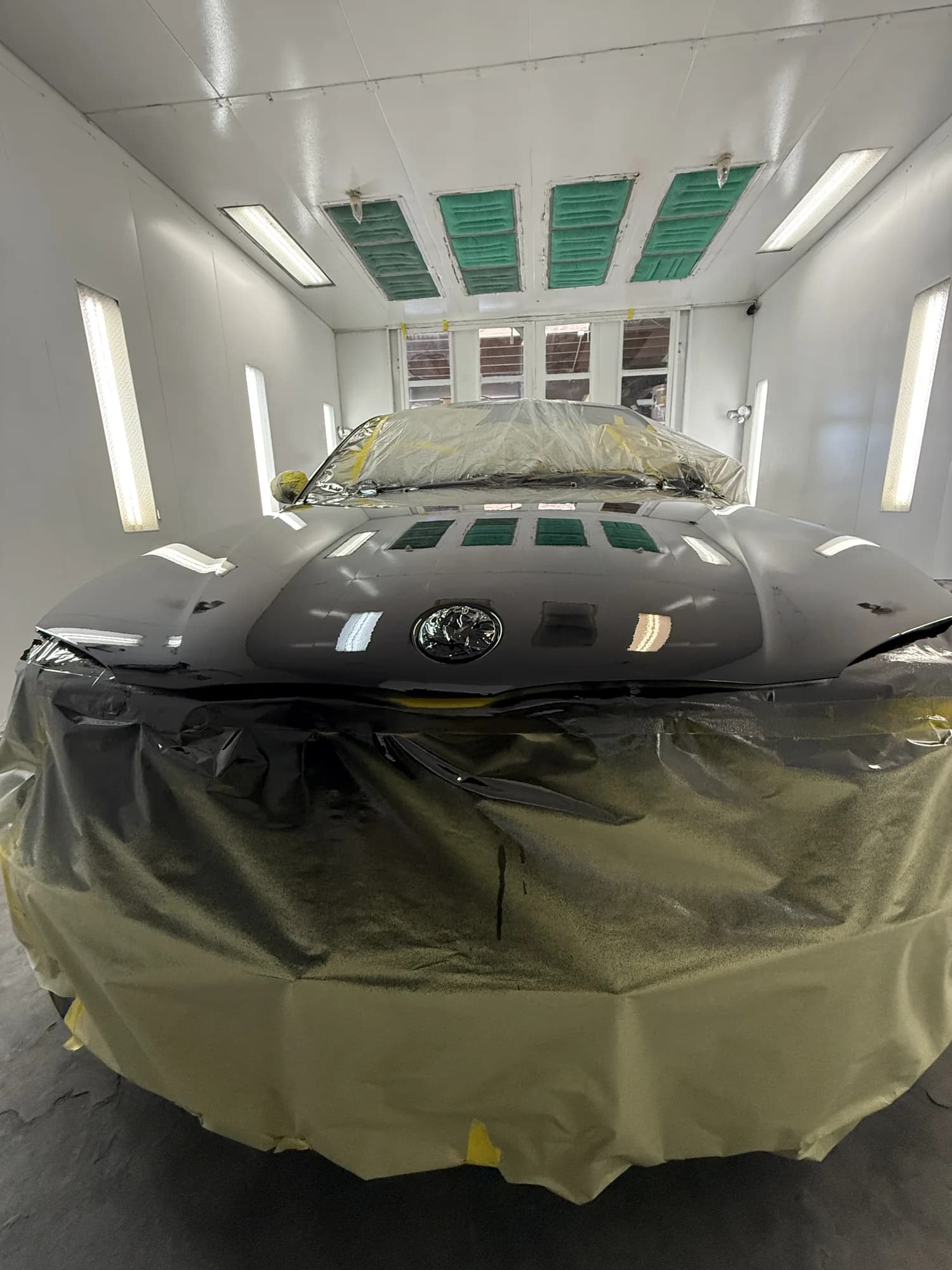
A correctly matched repair should be invisible in daylight, and getting there takes considerably more than looking up your paint code. The code tells a shop what the factory sprayed. It does not tell them what your car looks like today after years of sun, and those are two different colors.
Car paint color matching is the part of a repair customers judge hardest and understand least. Here is what actually happens between your paint code and a panel that disappears into the ones either side of it.
Why your paint code is a starting point, not an answer
Every vehicle carries a paint code, usually on a sticker in the driver's door jamb and sometimes under the hood or in the glovebox. It identifies the factory color. Two things stop it from being the whole answer.
The first is factory variance. Vehicle manufacturers allow their paint suppliers roughly 5% variance from the original color standard, and assembly plants on opposite coasts can receive paint at opposite ends of that tolerance for the same code. [Source: PPG Refinish, Identify Color Formula] This is why professional refinish databases carry alternates: the average factory paint code has between three and seven alternate formulas, and some carry more than a dozen.
The second is age. Ultraviolet exposure shifts paint over time. Reds fade fastest and dark colors lose depth. A car parked outside on the Peninsula collects a lot of sun and a lot of salt air, so a five-year-old silver is no longer factory silver. Matching the code rather than the car is precisely how a door ends up half a shade off.
How a shop reads the car instead of the chart
This is where the real matching happens. The shop scans the existing finish and selects the closest variant from the alternates available for that code, then proves it before anything reaches your car.
The proof is a spray-out card: the mixed color sprayed onto a test card, clear-coated and cured exactly as the real panel will be, then held against your actual paint in daylight. Adjust, spray again, check again. Under shop fluorescent lighting almost anything looks close. Outside is where a mismatch shows itself, which is why the check happens outside.
Metallics and pearls add a second problem. They change appearance with viewing angle, so a card has to be checked straight on and from the side. A pearl white that matches perfectly head on can flash a different tone at forty five degrees. The industry-standard sequence is to spray the card while edging the parts where possible, verify a blendable match, and only then mix enough basecoat for the entire repair. [Source: PPG Refinish, Identify Color Formula standard operating procedure]
Blending is what makes the repair disappear
Here is the part most drivers have never been told. Even a perfect mix, sprayed only on the repaired panel and stopped at the panel edge, can be detectable. A hard line between old paint and new gives the eye a reference point, and the eye is very good at finding one.
So the new color is blended: extended progressively into the adjacent panels, with clear coat applied across the whole area. There is no line for your eye to catch on because there is no line. This is why a scratch on one door frequently means paint work touching the fender or the rear door as well. It is not an upsell, it is the technique that makes the repair invisible, and an estimate without a blend line is describing a different and more visible repair.
Blending is a defined step rather than a flourish, and it comes before the color is committed to. The refinish procedure is to spray the test card, confirm a blendable match against the vehicle, and only then mix enough basecoat for the whole repair. [Source: PPG Refinish, Identify Color Formula standard operating procedure] A shop that mixes first and checks later has already spent the material and has an incentive to call it close enough.
The economics follow from all of this. Refinishing is labor rather than material, and blending extends that labor across more surface. Cosmetic dents where the paint is intact skip the sequence entirely, which is the real argument for paintless dent repair whenever it is available.
The colors that are hardest to match
- Three-stage pearls, including many pearl whites and candy reds. Three separate layers, and the middle one controls the entire effect.
- Silvers and light metallics. Unforgiving. The metallic flake has to lie down the way it did at the factory, which depends on spray technique rather than on the mix.
- Faded reds. Red pigment breaks down under ultraviolet light faster than anything else, so on a sun-baked older car the current color is nowhere near the code.
- Matte and satin finishes. No clear coat to hide behind and no polishing afterward. What gets sprayed is what stays.
None of these are impossible. They take longer, and a shop that does not mention the difficulty before starting has probably not planned for it. Ask which category your color falls into when you get the estimate, alongside the other questions worth asking about how long the repair will take.
What to check before you accept the car
- Look at it outside, in daylight. Never judge paint under fluorescent light.
- Walk around it. Straight on, then from a low angle, then from each side. Metallics reveal themselves at an angle.
- Check it wet and dry. Water temporarily changes how a finish reads.
- Look at panel edges and door jambs. A hard line, overspray on rubber trim, or masking tape lines are workmanship problems rather than color problems.
- Run a hand over it. A good finish is smooth. Grit under the clear means something landed in it before it cured.
If something looks wrong, say so before you leave. A color or finish issue raised at handover is a conversation. The same issue raised three weeks later is an argument.
How we match paint in South San Francisco
We match against your vehicle's paint code by computer, verify the chosen variant against the car itself before anything goes on a panel, and blend into the surrounding panels rather than stopping at an edge. If your color is one of the difficult ones, we will tell you up front rather than afterward.
We have been refinishing Peninsula vehicles since 1987 at 136 South Linden Ave, two minutes from the 101 and the I-380 interchange, and we are family owned. Estimates are free and written. You can look at finished work before you commit to anything, which is a more useful test of a paint shop than any description. More on auto painting and refinishing and auto body repair.
Common questions about car paint color matching
Why does the shop need to paint panels that were not damaged?
Because stopping new paint at a panel edge creates a visible line. Blending extends the new color progressively into the adjacent panels and applies clear coat across the whole area, so there is no boundary for your eye to detect. It is the difference between a repair you cannot find and one you notice every time you walk up to the car. If an estimate does not include a blend operation, ask why, because two estimates that differ by a blend line are not quoting the same repair even when the damaged area is identical.
Will the new paint fade at the same rate as the rest of the car?
Not at exactly the same rate, because the new paint starts unfaded while the surrounding panels have already lost some pigment to ultraviolet exposure. A good match accounts for the car's current condition rather than its factory color, so the repair looks correct today. Over the following years the newer paint weathers more slowly than the older paint around it, though modern clear coats have narrowed this considerably. Keeping the car washed and occasionally waxed slows fading across the whole vehicle and keeps the panels aging together.
Can a shop match paint without the paint code?
Yes, though the code makes it faster and more reliable. Where a code sticker is missing or unreadable, a shop can scan the existing finish directly and build a formula from that reading, then prove it with a spray-out card exactly as it would otherwise. The code is really a shortcut to the right starting formula rather than the answer itself, since the card has to be verified against the car in either case. If your sticker has faded, mention it when booking so time is allowed for the extra step.
How long does paint need to cure before I can wash the car?
Ask your shop for their specific guidance, because it depends on the products used and how the finish was cured. As a general rule, hand washing with plain water and a soft mitt is fine within a few days, while waxing and automatic car washes with brushes should wait considerably longer so the finish can harden fully. Avoid parking under trees during that period, since sap and bird droppings can mark fresh clear coat more easily than cured paint.
Worried the color will not match? That is a fair worry and the answer is visible before you commit. Bring the car to our South San Francisco shop or send photos for a free written estimate.
Got a question about your own car? Call (650) 952-6036 or send us a few photos for a free estimate.
Bring us the car.
Call the shop and talk to someone who'll actually look at it, or send a few photos and we'll come back to you with an estimate.