
7 Brake Warning Signs You Shouldn't Keep Driving On
October 18, 2026 · 7 min read
Grinding, a soft pedal, a pull to one side. Five of these mean book an appointment. Two of them mean stop driving the car today and call a tow.
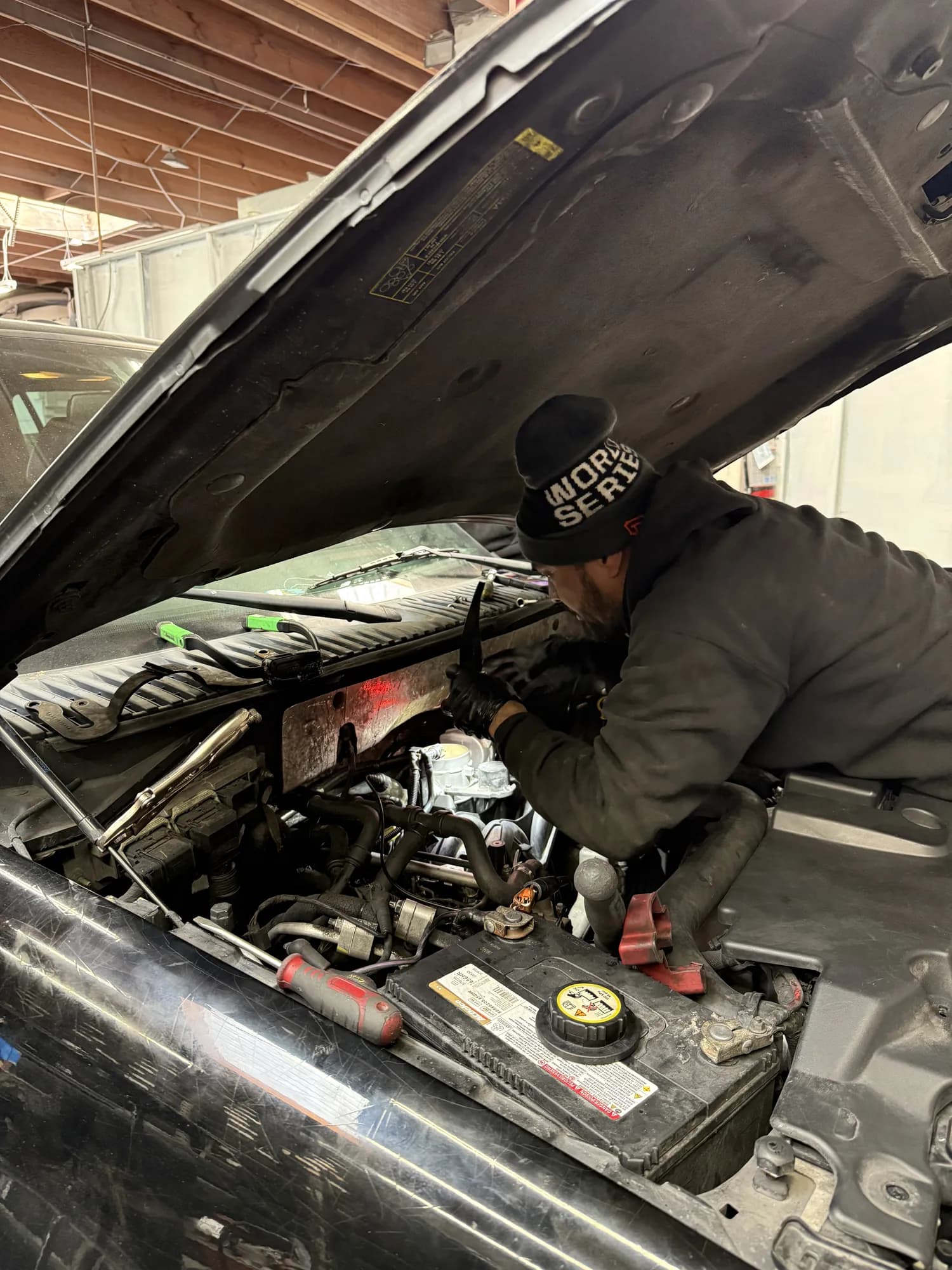
Brakes almost always warn you before they fail. The warnings arrive as noise, as a change in how the pedal feels, or as a change in how the car behaves when you stop. Two of them mean stop driving today: a pedal that sinks toward the floor, and a brake warning light combined with any change in pedal feel.
The difficulty is that the cheap warning and the dangerous one can feel similar from the driver's seat. Here are the seven brake warning signs worth knowing, what each usually means, and which ones are a tow rather than an appointment.
Why brake problems are worth catching early
Mechanical failure causes a small share of crashes, but brakes are the largest slice of that share. In the National Motor Vehicle Crash Causation Survey, a vehicle component failure or degradation was the critical reason in about 2% of crashes. [Source: NHTSA, Critical Reasons for Crashes Investigated in the National Motor Vehicle Crash Causation Survey] Within vehicle-related crashes, defective brakes are consistently the leading single factor.
Two percent sounds small until you notice what it excludes: every occasion where worn brakes lengthened a stopping distance enough to turn a near miss into a collision that was then recorded as driver error. Brakes rarely get named as the cause. They quietly change the margin you had.
The seven brake warning signs
Five of these are an appointment and two are a tow. The ordering below is roughly by how much time you have, not by how loud the symptom is, because the quietest one on the list is the most dangerous. Brake defects account for the largest share of vehicle-related crashes in NHTSA's crash causation data, and the pattern in that data is a gradual loss of margin rather than a sudden failure. [Source: NHTSA, National Motor Vehicle Crash Causation Survey]
1. Squealing when you brake
A high-pitched squeal, often worse in the morning or in damp weather. Many pads carry a built-in wear indicator, a small metal tab that contacts the rotor once the friction material runs low, deliberately, to make this exact noise. Get it inspected within a week or two. Caught here it is a pad replacement.
2. Grinding or metallic scraping
A deep grinding sound, sometimes with vibration through the pedal. Usually metal on metal: the friction material is gone and the pad backing plate is cutting into the rotor. Have it seen immediately. Stopping distances are already longer than they should be, and every further day of driving scores the rotors, turning a pad job into pads plus rotors.
3. A soft or spongy pedal
The pedal feels mushy, or travels further than it used to before the car slows. Common causes are air in the lines, moisture-contaminated fluid, or a leak. Get it checked promptly, because a hydraulic problem does not stabilise on its own.
4. The pedal sinks toward the floor
You press and the pedal keeps going, or it slowly drops while you hold it at a light. This points to hydraulic failure: a leaking line, a failing master cylinder, or a caliper losing pressure. Stop driving the car. This is the symptom whose failure mode is no brakes. Have it towed.
5. The car pulls to one side when braking
The steering wheel wants to go left or right under braking. Usually a sticking caliper, uneven pad wear, or a collapsed brake hose, so one wheel does more of the work. Get it seen this week. Beyond the imbalance, a stuck caliper builds heat and destroys the pad and rotor on that corner.
6. Vibration or pulsing through the pedal
A rhythmic pulse through the pedal or steering wheel under braking, worse at freeway speeds coming down the 101 or 280. Typically warped or unevenly worn rotors, often heat-related and common on cars doing a lot of stop-and-go or long downhill braking. Rotors can sometimes be resurfaced; below minimum thickness they get replaced.
7. A brake warning light
Two different lights matter. A brake system light can mean low fluid or a hydraulic fault. An ABS light means the anti-lock system has faulted: your normal brakes still work, but you do not have anti-lock assistance in an emergency stop. A brake system light together with any pedal symptom means stop driving and get it towed. An ABS light alone means get it diagnosed soon and drive gently until then.
The two that mean stop today
A pedal that sinks or keeps travelling, and a brake warning light combined with any change in pedal feel. Both indicate the hydraulic system is losing its ability to hold pressure, and neither gives reliable warning before going completely.
The reason to take this seriously is that the assist systems layered on top of your brakes do not substitute for them. Automatic emergency braking and anti-lock systems act through the same hydraulic circuit, and modern vehicles carry more of this equipment than ever: CCC found 28.3% of repairable estimates now include a calibration operation, an indication of how much of the braking and driver assistance function is now electronically mediated. [Source: CCC Intelligent Solutions, Crash Course 2026, reported by Autobody News] None of it helps if the fluid cannot hold pressure. Everything else on this list is a repair. These two are a tow.
Why waiting makes brakes expensive
The pattern is consistent and it compounds in one direction. Pads caught at the squeal are the cheapest brake job available. Left until grinding, the rotors go too. Left further, a seized caliper joins the list, and heat damage can reach the hub and the wheel bearing. The same corner of the same car, three times the bill, for the sake of a few weeks.
The same logic applies to the systems around the brakes. Uneven pad wear frequently traces back to a suspension or alignment problem that will keep destroying pads until it is addressed, which is why a brake inspection worth having also looks at tires and wheel alignment. A pull under braking that turns out to be alignment rather than a caliper is a cheaper answer, and you only find it by checking both. More on diagnostics and general mechanical repair.
How we inspect brakes in South San Francisco
We inspect and repair brakes including pads, rotors, calipers, lines and fluid, and we tell you what actually needs replacing and what has life left in it. "Replace everything" is a quote, not a diagnosis.
We are at 136 South Linden Ave in the Lindenville district, two minutes from the 101 and the I-380 interchange, family owned and working on Peninsula vehicles since 1987. Because we do body and mechanical work under one roof, a car that arrives for collision repair also gets its brakes looked at rather than handed to somebody else. More on brake repair, or see the full list of services.
Common questions about brake warning signs
How long can I drive on squealing brakes?
A wear indicator squeal means the friction material is low but present, so you generally have some weeks rather than some months. It is not an emergency and it is also not something to ride out until the noise changes, because the next stage is the backing plate contacting the rotor and that converts a pad replacement into pads and rotors. If the squeal only appears on the first stop of a cold damp morning and then disappears, that is often surface rust burning off rather than wear. A squeal that persists once the brakes are warm is the one to act on.
What is the difference between the brake light and the ABS light?
The brake system light generally indicates low fluid, a hydraulic fault, or in some vehicles simply an engaged parking brake. The ABS light indicates a fault in the anti-lock system specifically, which means your ordinary brakes still function but you lose anti-lock assistance during an emergency stop. The ABS light alone is not a reason to stop driving, though it should be diagnosed soon and you should leave more following distance until it is. A brake system light accompanied by any change in pedal feel is a different situation entirely and means stop.
Do brake pads and rotors always need replacing together?
No, and a shop insisting they do is describing its own policy rather than your car. Rotors have a manufacturer-specified minimum thickness, and a rotor comfortably above it with an even surface can often be resurfaced or simply left alone while the pads are replaced. Rotors do need replacing when they are below minimum, deeply scored by worn-out pads, or warped past what resurfacing can correct. Ask for the measured thickness rather than an opinion, because the number either supports replacement or it does not.
Why do my brakes squeal only in the morning?
A light surface layer of rust forms on rotors overnight, particularly in damp coastal air, and the first few stops scrape it off with some noise. This is normal and needs no action if the sound disappears within the first mile and the pedal feels ordinary. It becomes worth investigating when the noise continues once the brakes are warm, when it changes to a grinding note, or when it is accompanied by any vibration or pull. Cars parked outside near the bay do this more than cars kept in a garage.
If you are hearing something you do not like, get it looked at before it becomes three repairs instead of one. Call us, bring the car to our South San Francisco shop, or get in touch for a free inspection.
Got a question about your own car? Call (650) 952-6036 or send us a few photos for a free estimate.
Bring us the car.
Call the shop and talk to someone who'll actually look at it, or send a few photos and we'll come back to you with an estimate.