
Frame Damage: When a Car Is Repairable and When It's Totaled
October 15, 2026 · 7 min read
Most frame damage is repairable. California decides the rest with a formula, not a percentage, and knowing it is what lets you argue with a total loss you disagree with.
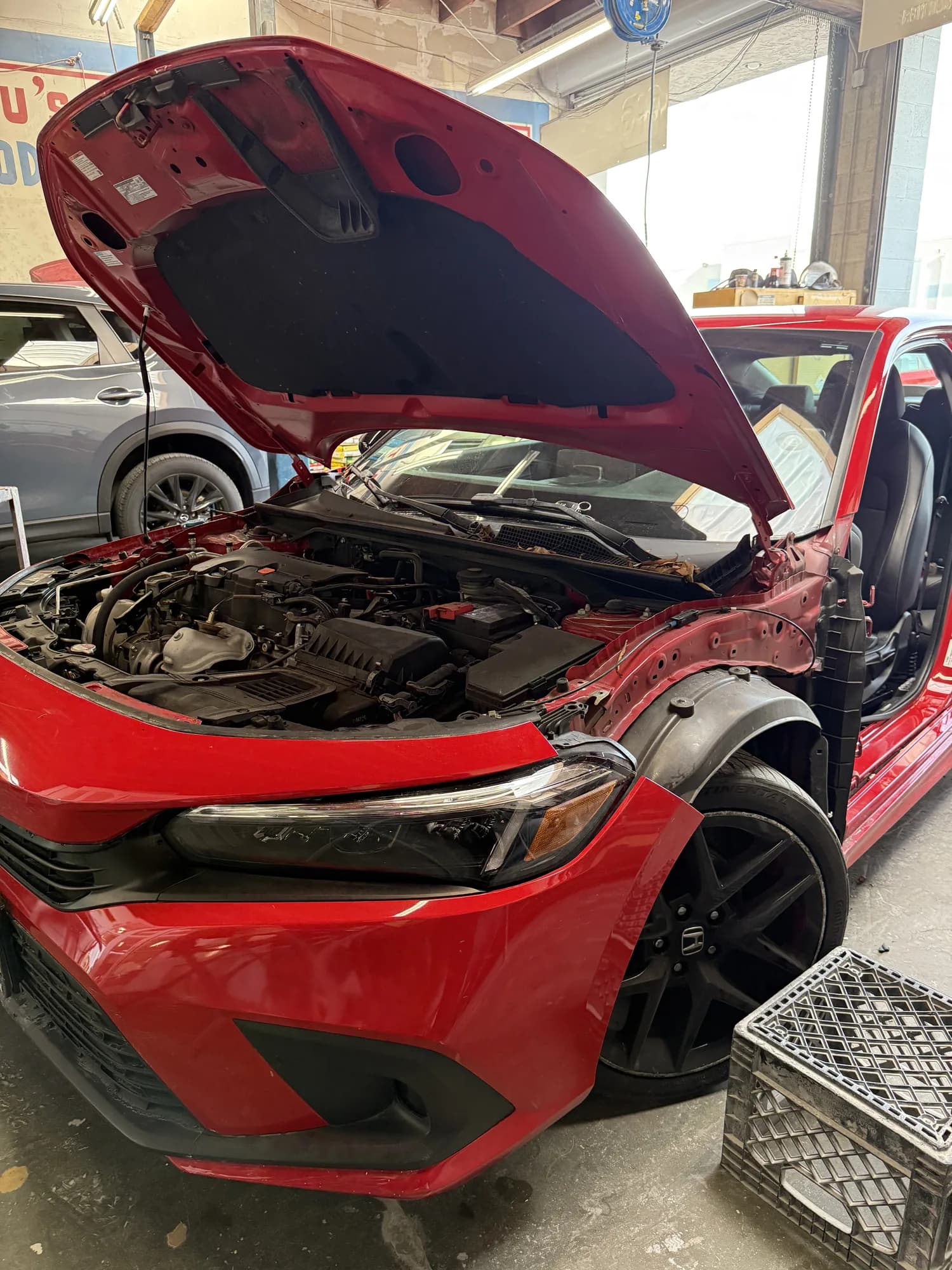
Most frame damage is repairable. Modern unibody structures are engineered to crumple in a collision, because that is how they absorb energy instead of passing it to the people inside, and straightening them back to factory specification is established, measurable work.
Whether your car gets repaired or written off is usually not a question of whether it can be fixed. It is arithmetic your insurer performs, and in California that arithmetic has a specific legal form worth understanding before you accept anyone's verdict.
How California actually decides a car is totaled
California does not use a fixed percentage. State law applies a total loss formula: if the cost of repairs plus the salvage value equals or exceeds the vehicle's actual cash value, the car is a total loss. California Vehicle Code section 544 defines a total loss salvage vehicle as one damaged to the point that it is uneconomical to repair. [Source: California Vehicle Code sections 544 and 11515]
Separately from the statute, most California insurers apply internal thresholds somewhere in the range of 70% to 80% of actual cash value. Those are company policies rather than legal requirements, which matters: a threshold is negotiable in a way a statute is not.
Either way, the decision is financial rather than structural. It produces a result that surprises people constantly. An older car with modest damage gets written off while a newer car with severe damage gets repaired. A fifteen-year-old sedan worth $4,000 is totaled by a $3,200 repair; a three-year-old SUV worth $38,000 has $19,000 of structural work approved. The second car took far more damage. So "they totaled it" does not mean "it was unsafe to fix", and "they approved the repair" does not mean the damage was minor.
Total losses are at a record high, and that is not about your car
CCC Intelligent Solutions reported that 23.1% of auto claims now result in a total loss, a new high. [Source: CCC Intelligent Solutions, Crash Course 2026, reported by Autobody News] Close to one claim in four.
The drivers are economic rather than structural. The vehicle fleet is aging, which lowers actual cash values, while repair costs per job keep climbing as vehicles carry more technology. When the value goes down and the repair cost goes up, more cars cross the line without anyone's car being more damaged than it used to be.
Technology is a real part of that climb. CCC found 28.3% of repairable estimates now include at least one calibration operation. [Source: CCC Intelligent Solutions, Crash Course 2026, reported by Autobody News] Every sensor that has to be replaced and recalibrated pushes a borderline repair closer to the threshold.
Signs of structural damage, and how it gets assessed
Worth having measured after any significant impact:
- Uneven panel gaps. A door gap wider at the top than the bottom, or a hood sitting proud on one side.
- Doors that no longer close cleanly or need a shove.
- The car pulls or tracks oddly. The steering wheel is straight but the car drifts, or the rear does not follow the front.
- Uneven tire wear soon after an accident, especially on one side.
- Visible kinks or wrinkles in the rails under the hood, the trunk floor, or along the rocker panels.
- New rattles, squeaks or wind noise at speed.
Measured, not eyeballed
None of those signs is a diagnosis on its own, which is why the assessment is a measurement rather than an opinion. It matters more than it used to: with 23.1% of claims now ending as total losses, the measured repair cost is what decides which side of California's total loss formula your car falls on. [Source: CCC Intelligent Solutions, Crash Course 2026, reported by Autobody News]
Assessment is not done by looking. The vehicle is measured against the manufacturer's dimensional specification, the reference points it was built to. Measured deviation is what tells a shop whether a rail has moved three millimetres or thirty, and whether it can be pulled back or has to be sectioned and replaced.
Then two rules apply. Bent metal can usually be straightened; kinked metal has to be replaced. A kink is a sharp fold where the metal's grain structure has failed, and pulling it straight leaves a weak point that will not behave predictably in a second collision. Separately, some sections are replace-only by design, because certain high-strength steel and aluminum components lose the properties they were engineered for when heated or pulled. A shop ignoring that hands you back a car that looks correct and no longer protects you the way it was built to.
What to do if your car is declared a total loss
- The valuation is negotiable. California law fixes the formula, not the inputs, and the inputs are where the argument is. [Source: California Vehicle Code sections 544 and 11515] Insurers value from market data. If comparable local listings are higher, or the car has recent major work such as new tires or a rebuilt transmission, provide the receipts and the listings.
- You can usually retain the vehicle. You keep it, the insurer deducts the salvage value, and it receives a salvage title. Worth considering when the damage is cosmetic-heavy and you plan to keep the car, though it is hard on resale.
- Get your own estimate. Because the California formula turns on repair cost, salvage value and actual cash value together, an independent repair estimate that comes in lower can change the outcome. This is the single most useful thing you can do, and it costs nothing.
Your choice of shop is yours throughout this process, including while a total loss is being disputed. More on your right to choose your own shop and on how we handle claims.
How we assess frame damage in South San Francisco
We perform frame and structural repair measured against factory specification, and we will tell you honestly when a car should not be brought back. That answer is worth more to you than the job is to us, and a shop willing to give it is the one you want measuring your car in the first place.
We are at 136 South Linden Ave in the Lindenville district, two minutes from the 101 and the I-380 interchange, repairing Peninsula vehicles since 1987 and family owned throughout. A lot of our structural work arrives straight off those interchanges. Body and mechanical work happen under one roof, so suspension and steering geometry get checked as part of the same visit rather than being someone else's problem. More on frame and structural repair, collision repair and wheel alignment.
Common questions about frame damage
Is a car with repaired frame damage safe to drive?
When the repair was done to the manufacturer's specification and verified by measurement, yes. That qualification carries the whole answer. A structure pulled back within factory tolerance and with replace-only sections actually replaced performs as designed in a subsequent collision. A structure straightened by eye, or one where a kinked high-strength component was pulled rather than replaced, may look identical and behave very differently. Ask for the measurement documentation, which any shop doing this work properly will have, because it is the only evidence that distinguishes the two.
Does frame damage always mean my car will be totaled?
No, and the assumption costs people cars they could have kept. California applies a total loss formula comparing repair cost plus salvage value against the vehicle's actual cash value, so the outcome depends as much on what your car is worth as on how badly it is damaged. Severe structural damage on a valuable late-model vehicle is frequently repaired, while moderate damage on an older car crosses the line. If you have been told the car is a write-off and you would rather keep it, an independent repair estimate is the thing that can change the arithmetic.
Do I have to disclose frame damage when I sell the car?
If the vehicle received a salvage or branded title, that brand follows the car and appears in its history, so it is disclosed whether or not you mention it. For a repaired vehicle that was never declared a total loss there is no title brand, though structural repairs commonly appear in commercial vehicle history reports and are detectable by any competent pre-purchase inspection. The practical advice is to keep your repair documentation and be straightforward about it, because a buyer who discovers it themselves assumes the worst about everything else.
How much does frame repair cost?
There is no useful average, because the work ranges from pulling a rail back a few millimetres to sectioning and replacing structural components. What determines the figure is how far the structure moved, whether the affected sections are repairable or replace-only by design, and how much cosmetic repair sits on top once the structure is correct. It is also the category most likely to grow after teardown, since structural damage is frequently accompanied by damage that photographs cannot show. Expect a provisional estimate first and a supplement once the car is apart.
If you have been told your car has frame damage, or something has felt wrong since an accident, get it measured before you accept anyone's verdict. Bring it to our South San Francisco shop or send us photos for a free written estimate.
Got a question about your own car? Call (650) 952-6036 or send us a few photos for a free estimate.
Bring us the car.
Call the shop and talk to someone who'll actually look at it, or send a few photos and we'll come back to you with an estimate.