
How to Choose a Body Shop in South San Francisco
October 22, 2026 · 8 min read
Three shops, three numbers, hundreds of dollars apart. Ten questions to ask first, how to read an estimate line by line, and the four signs to walk away.
Choosing a body shop in South San Francisco comes down to four questions: will they measure the structure rather than eyeball it, will they blend the paint rather than stop at a panel edge, who chases your insurer for the supplement, and will they tell you which parts are going on your car. Compare those answers, not the totals.
Nobody researches body shops until they need one, and by then the car is damaged, an adjuster is calling and three shops have quoted three numbers hundreds of dollars apart. The instinct is to take the cheapest. It is also the most reliable way to pay twice.
Why the cheapest estimate is rarely the same repair
A collision repair is one of the few purchases you cannot inspect. The paint prep is under the color. The structural work is under the panels. Six months later the finish either holds or it lifts, and the door either still closes cleanly or it does not.
Two estimates that differ by several hundred dollars usually differ by an operation, and blending is the most common one missing. Manufacturers allow their paint suppliers roughly 5% variance from the original color standard, and a single factory paint code commonly carries three to seven alternate formulas in refinish databases. [Source: PPG Refinish, Identify Color Formula] Spraying a code straight from the can and stopping at the panel edge is cheaper, faster, and visible in daylight for as long as you own the car.
Calibration is the other line that quietly disappears. CCC found 28.3% of repairable estimates now include at least one calibration operation. [Source: CCC Intelligent Solutions, Crash Course 2026, reported by Autobody News] If your car has parking sensors, forward radar or a front camera and the estimate does not mention calibration, either it is not needed or it is not being done, and those are very different things.
Ten questions to ask before you hand over the keys
Ask these on the phone. You will learn more in four minutes than from an hour of reading reviews.
- Is the estimate free and in writing?
- Will you measure the structure, and against what specification?
- What parts are you using, and are they identified on the estimate as OEM, aftermarket or recycled?
- Who handles the supplement if you find more damage, you or me?
- What does your workmanship warranty cover, and for how long?
- Does my car need calibration afterward?
- What is the realistic completion date, and what would change it?
- Are all the parts in stock, or on order?
- Is the paint matched to my paint code and verified against the car itself?
- Can I see finished work?
Question six is worth pressing on, because the cost is real. AAA testing found driver assistance systems can add up to 37.6% to total repair cost after a crash, with sensor repair and calibration alone adding up to $3,000. [Source: AAA, ADAS Sensor Calibration Increases Repair Costs] A shop that has not looked up whether your vehicle needs it has not read the manufacturer's repair procedure.
If a shop will not put a completion date in a sentence, that is your answer.
How to read a body shop estimate
A real estimate is a list of operations, not a number. It is also provisional by nature: teardown routinely reveals damage photographs cannot show, which is why supplements are normal rather than a sign something went wrong. With 23.1% of claims now ending as total losses, the supplemented figure is also what decides whether your car gets repaired at all. [Source: CCC Intelligent Solutions, Crash Course 2026, reported by Autobody News]
| Line item | What it means | Why the price moves |
|---|---|---|
| R and I (Remove and Install) | Trim, lights or sensors come off and go back | Newer cars hide sensors and cameras in bumpers |
| Repair vs Replace | Panel worked back, or a new one fitted | Repair is often cheaper; a torn panel is not repairable |
| Refinish | Prep, prime, color, clear on the panel | The bulk of labor on any painted repair |
| Blend | Color extended into adjacent panels | Prevents a visible line at the panel edge |
| Supplement | Damage found after teardown | Near universal; photo estimates are provisional |
| Calibration | Driver assistance systems reset after repair | Required on many post-2018 vehicles |
Two checks specifically. If one estimate has no blend line and another does, they are not the same repair. And if an estimate is one line and a total, you do not know what you are buying and neither will the adjuster. For the small end of the scale, our breakdown of what bumper repair actually costs shows how the operations stack up.
Four warning signs to walk away from
"Your insurance company requires you to use us." False in California. Insurance Code section 758.5 prohibits an insurer from requiring a specific repair shop or implying your coverage depends on one. [Source: California Insurance Code section 758.5, official text] A shop telling you otherwise is misrepresenting the law. More on your right to choose your own shop.
An offer to cover your deductible or inflate the claim. That is insurance fraud and your name is on the policy.
A firm price with no inspection. A number given sight unseen is a number that will change, or a repair that skips whatever it did not cover.
Pressure to sign a blank authorization. Authorize a specific repair against a specific written estimate, never an open one.
One thing worth verifying yourself: that the shop is properly registered. California's Bureau of Automotive Repair holds licence and complaint records. Reviews tell you about the experience; the licence tells you about the business.
What matters specifically in South San Francisco
Local details here are not filler, they change your week. A lot of collision work in this city comes off the 101 and I-380 interchanges and the South Airport Boulevard on-ramps, and the distinction between drivable and not is expensive: Enterprise data for the second quarter of 2026 put average collision-related rental at 14.1 days for drivable vehicles against 20.7 days for non-drivable ones. [Source: Enterprise Mobility rental length data, Q2 2026] A shop minutes from those ramps means one short tow rather than a car sitting in a lot across the county.
The Lindenville industrial district, along South Linden Ave east of El Camino Real, is where the body shops and trade suppliers sit. Space matters more than it sounds: a shop with room to store a vehicle can hold your car while a claim is agreed rather than pushing you to decide before the adjuster has responded.
Language matters too. South San Francisco is a mixed city and describing an accident accurately is hard enough in your first language. And because real collisions are rarely only cosmetic, a shop doing both body and mechanical work means one visit and one point of accountability rather than a body shop pointing at a mechanic and back.
How we quote work in South San Francisco
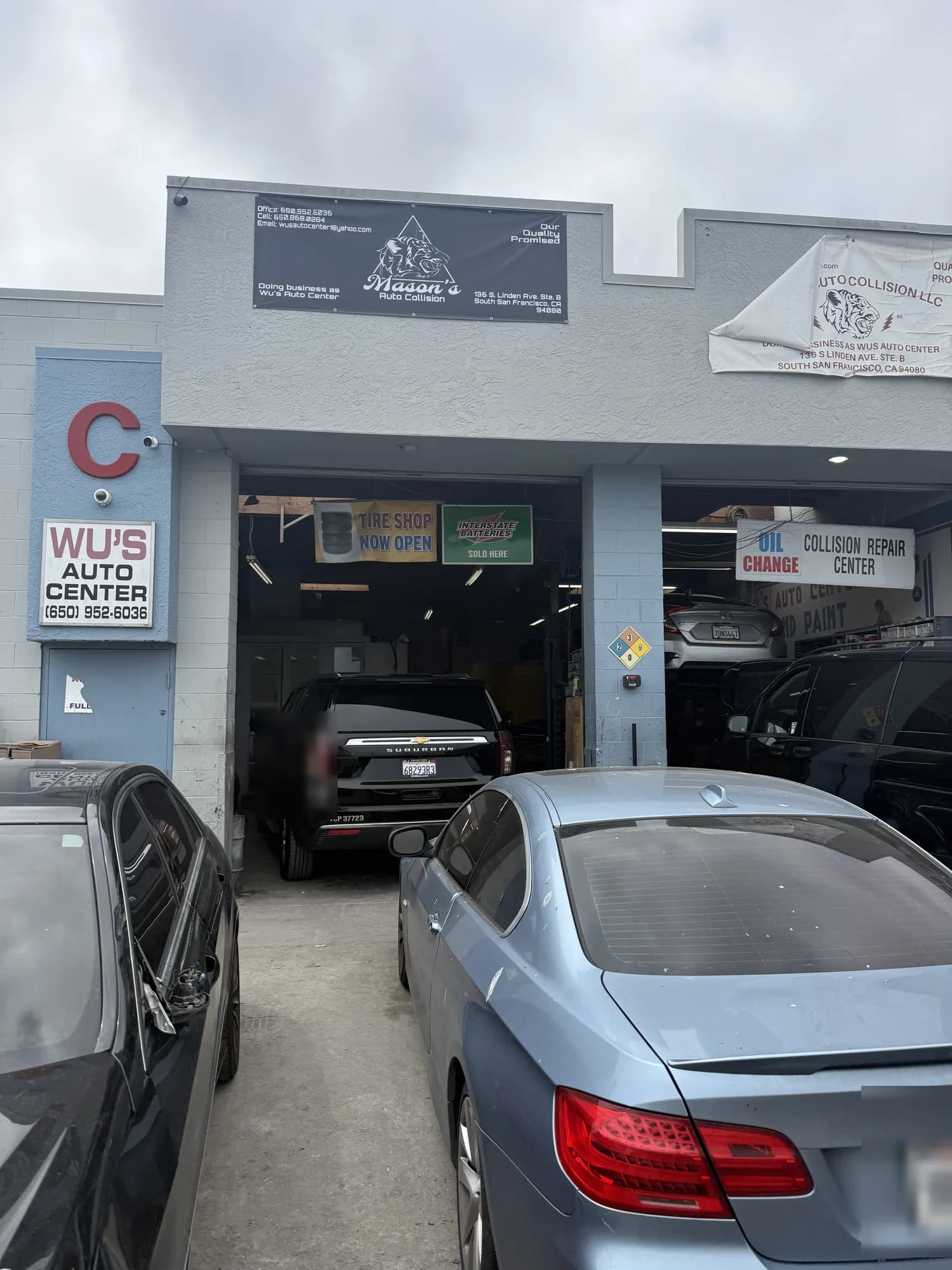
We have been repairing Peninsula vehicles since 1987, family owned, at 136 South Linden Ave in the Lindenville district, two minutes from the 101 and the I-380 interchange. We measure to factory specification, match paint to your vehicle's code and verify it against the car, blend into the surrounding panels, and handle the estimate, the adjuster and the supplements ourselves. Estimates are free and written, in English, Spanish or Arabic.
More on collision repair, auto painting, frame and structural repair and insurance claims, or look at finished work first.
Common questions about choosing a body shop
How do I choose a body shop in South San Francisco?
Compare what each shop proposes to do rather than what each one charges. Ask whether the estimate is free and written, whether the structure will be measured against factory specification, which parts are being used, and who handles the insurance supplement. A shop that answers all four specifically is a different proposition from one quoting a number over the phone. Then check that the estimate includes a blend operation and, if your car carries driver assistance sensors, a calibration line. Those two omissions account for most of the gap between a cheap quote and a complete one.
Why are body shop estimates so different from each other?
Because they usually describe different repairs. One may include blending paint into the adjacent panels while another stops at the panel edge, one may plan to repair a panel the other replaces, and one may have looked up whether the vehicle needs calibration while the other has not. Compare the line items and the difference almost always appears in an operation that one estimate left out. A lower total is only a better deal if the two documents describe the same work, which in practice they rarely do.
Should I get more than one estimate?
Two is useful, mainly to see whether the operations match. Beyond that you get diminishing returns and a delayed repair, and the car is usually sitting damaged while you collect quotes. If one estimate comes in dramatically lower, the productive question is what it does not include rather than assuming you found a bargain. Bring the cheaper document to the other shop and ask them to explain the difference, because a shop confident in its estimate will walk you through it line by line.
How long will my car be in the shop?
A light cosmetic repair runs two to four days, a moderate repair one to two weeks, and structural work three weeks or more, with the national average collision-related rental sitting at about 15 days. Most delays come from supplement approval and back-ordered parts rather than from the work itself, and calibration adds several days when multiple systems are involved. Ask for the realistic date and what would change it. Our full timeline breakdown goes through it stage by stage.
The shop you choose decides whether your car is measured or eyeballed, and whether the parts you cannot see were the right ones. Bring us the car at our South San Francisco shop, or send a few photos and we will give you a straight answer on what it needs.
Got a question about your own car? Call (650) 952-6036 or send us a few photos for a free estimate.
Bring us the car.
Call the shop and talk to someone who'll actually look at it, or send a few photos and we'll come back to you with an estimate.